Want a free landscape lighting demo? CALL NOW 719-284-3662

Path Lighting in Colorado Springs, Monument & Castle Rock
Path lighting serves as the foundation of a well-designed outdoor lighting system, providing critical illumination for walkways, steps, driveways, and grade changes throughout your property. More than just aesthetic enhancement, properly designed path lighting is a crucial safety feature that prevents accidents while creating inviting outdoor spaces you can enjoy day and night.
At Illumin8 Outdoor Lighting, we specialize in designing and installing custom path lighting systems throughout Colorado Springs, Monument, Castle Rock, Peyton, and Manitou Springs. Our technical expertise and knowledge of Colorado's unique environmental challenges ensure your path lighting system performs beautifully year-round while maintaining the highest standards of safety and energy efficiency.
Why Path Lighting is Essential for Your Property
Safety First: Preventing Accidents and Injuries
The primary function of path lighting is safety. Dark walkways, unmarked steps, and unlit grade changes pose serious hazards, particularly during Colorado's long winter months when darkness arrives early. Path lighting addresses these dangers by:
Illuminating grade changes - Even small elevation changes can cause dangerous trips and falls in the dark. Strategic path lighting clearly defines where terrain shifts, allowing safe navigation.
Marking steps and stairs - Outdoor stairways are particularly hazardous without proper lighting. Path lights positioned at each tread or riser eliminate this risk.
Defining walkway edges - In areas where walkways transition to landscaping or lawn, path lighting creates clear visual boundaries, preventing missteps.
Reducing liability - For both residential and commercial properties, proper path lighting demonstrates reasonable care in maintaining safe premises.
Dark Sky Compliance: Responsible Lighting for Colorado
Colorado's spectacular night skies are a treasure worth protecting. At Illumin8, we prioritize Dark Sky compliant lighting solutions that minimize light pollution while providing exceptional illumination where you need it. Our path lighting designs incorporate:
Downward-directed light - Fixtures are positioned and shielded to direct light only where needed, not into the night sky.
Appropriate lumen levels - We specify fixtures with proper output levels (140-250 lumens) that provide adequate safety lighting without over-illumination.
Warm color temperatures - We use 2700K-3000K color temperatures that are easier on the eyes and minimize impact on nocturnal wildlife.
Strategic placement - Careful fixture spacing and positioning ensures effective lighting without excessive fixture count.
Colorado Consideration: Our fixtures are designed to withstand Colorado's intense UV exposure at high altitude, dramatic temperature swings, and heavy snow loads. We use commercial-grade impaler stakes that resist damage from snow plows and freeze-thaw cycles that can heave standard stakes out of position.
Path Lighting Fixture Styles and Applications
Selecting the right fixture style is crucial for both aesthetic appeal and functional performance. Your path lighting should complement your home's architectural style while providing appropriate illumination for the specific application. Here are the primary fixture styles we recommend:
Modern Minimalist Designs
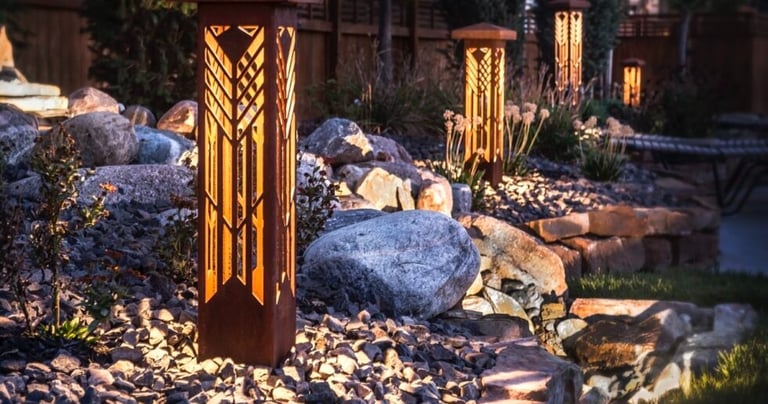
These sleek fixtures feature clean lines and small apertures that control light precisely. The compact design makes them nearly invisible during daylight while delivering focused, high-quality illumination at night. Ideal for contemporary homes and minimalist landscape designs where understated elegance is paramount.
Best for: Modern architecture, contemporary landscapes, tight spaces where fixture visibility should be minimized.
Traditional Mushroom Style
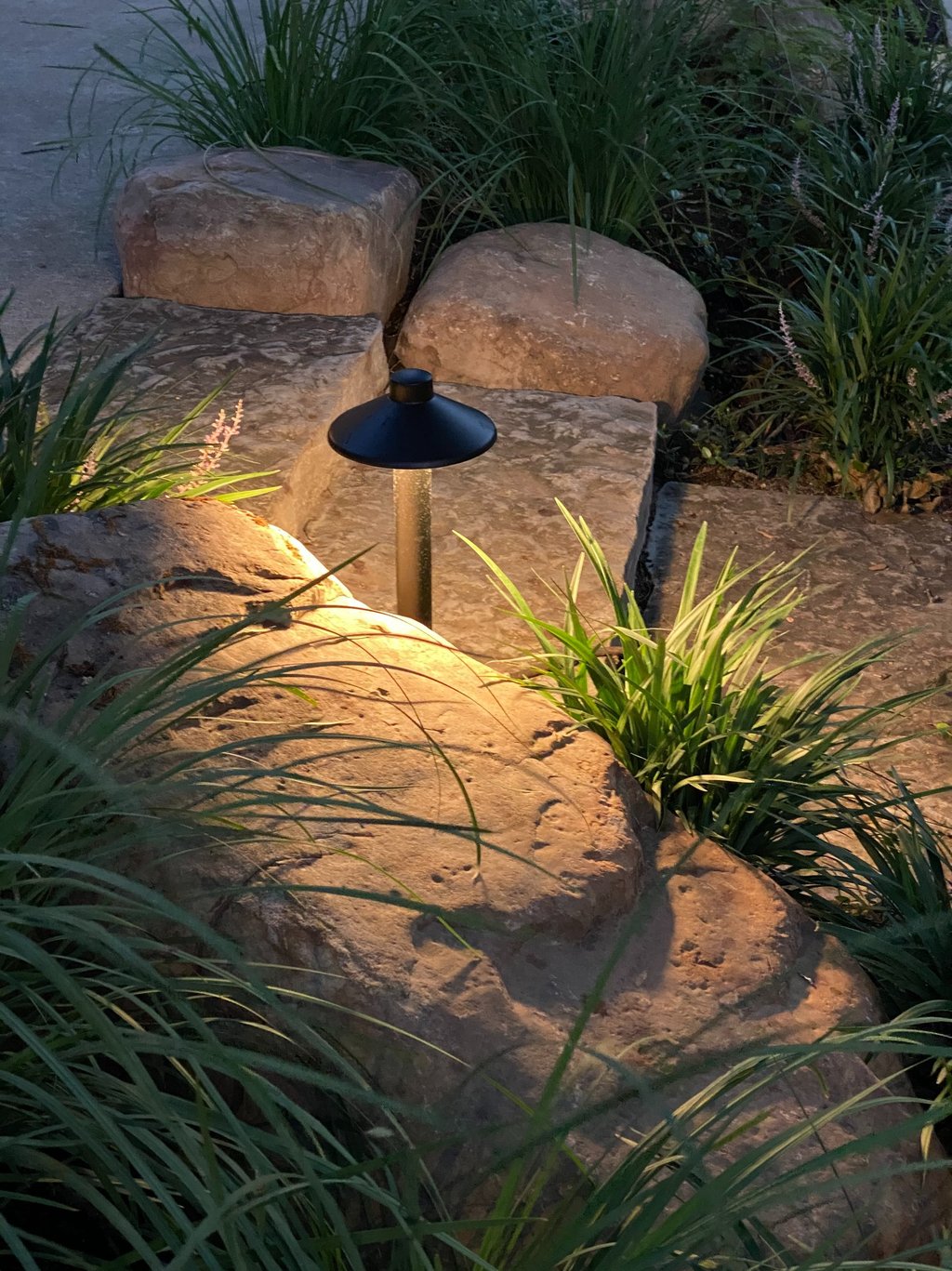
The classic mushroom-cap design provides 360-degree illumination with a distinctive, timeless appearance. These fixtures create broad pools of light perfect for general pathway illumination. Available in various sizes from 12" to 24" height, allowing customization based on landscape scale and lighting requirements.
Best for: Traditional homes, established landscapes, areas requiring broad illumination patterns.
Grade-Level Path Lights
Installed flush or nearly flush with the ground, these fixtures cast light horizontally across walkways and steps. They're particularly effective for steps and grade changes where you want to highlight the transition clearly without vertical fixture profiles that might interfere with plantings or sightlines.
Best for: Steps, tight planting beds, areas where above-ground fixtures might be obtrusive, modern hardscape applications.
Fixture Selection Based on Environment
The surrounding landscape significantly impacts fixture performance and selection. Understanding these relationships ensures optimal results:
Stepping Pads Surrounded by Plants
When path lights are positioned among dense plantings, surrounding foliage absorbs significant light output. For these applications, I recommend higher lumen fixtures (200-250 lumens) to ensure adequate illumination reaches the walking surface. The plants create natural shielding that helps prevent glare while the brighter output compensates for absorption.
Solid Concrete or Paver Walkways
Hard surfaces reflect considerably more light than plants or mulch. For continuous concrete or paver walkways, lower lumen fixtures (140-180 lumens) provide ample illumination while preventing uncomfortable glare. The reflective surface effectively amplifies the light output, making less powerful fixtures appropriate.
Brass vs. Aluminum: Material Selection Matters
The material your path light fixtures are constructed from significantly impacts longevity, appearance, and performance in Colorado's demanding climate.
Why We Recommend Brass Fixtures
Brass fixtures represent the gold standard in outdoor lighting durability and aesthetic appeal. Here's why brass is our primary recommendation:
Superior durability - Brass naturally resists corrosion and withstands decades of exposure to Colorado's UV radiation, temperature extremes, and moisture without degrading.
Natural patina development - Over time, brass develops a beautiful living finish that helps fixtures blend seamlessly into the landscape, becoming virtually invisible during daylight hours.
Heat dissipation - Brass's thermal properties effectively dissipate heat from LED components, extending bulb life and maintaining consistent performance.
Weight and stability - The substantial weight of brass fixtures provides excellent stability, resisting displacement from wind, impacts, or ground movement.
Long-term value - While brass fixtures carry a higher initial cost, their multi-decade lifespan makes them more cost-effective than replacing aluminum fixtures multiple times.
Aluminum Fixtures: When They Make Sense
Quality aluminum fixtures serve well in specific applications, particularly where budget constraints are significant or temporary installations are planned. Modern powder-coated aluminum resists corrosion reasonably well, though it lacks brass's inherent durability and natural aesthetic evolution. Aluminum fixtures work best in protected locations with less exposure to physical impacts.
Professional Insight: The natural patina that develops on brass fixtures is actually protective and desirable. As brass weathers, it transitions from its initial bright appearance to soft bronze and eventually to a subtle verdigris. This patina makes fixtures nearly invisible in landscape beds during daytime while maintaining full light output at night. Many clients initially concerned about this change come to appreciate how naturally their lighting blends into the environment.
Technical Specifications and Design Parameters
Electrical System: 12-Volt Low-Voltage Operation
All our path lighting systems operate on safe, efficient 12-volt electrical systems. Low-voltage lighting offers multiple advantages over line-voltage systems:
Safety - 12-volt systems pose minimal shock risk and can be installed by trained technicians rather than requiring licensed electricians for all aspects.
Flexibility - Low-voltage wire can be directly buried without conduit in most applications, simplifying installation and future modifications.
Energy efficiency - Modern LED fixtures operating at 12 volts consume minimal power while delivering excellent illumination.
Cost-effectiveness - Lower installation costs and reduced energy consumption make 12-volt systems economically superior.
Lumen Output: Right-Sizing Your Illumination
Proper lumen specification is critical for achieving balanced, comfortable illumination without glare or dark spots. Our approach considers both the application and surrounding plant materials.
Beam Spread and Light Distribution
The pattern in which light is distributed significantly impacts both aesthetics and functionality:
360-Degree Distribution
Full circular light distribution is our standard recommendation for most path lighting applications. 360-degree fixtures create uniform pools of light that illuminate all directions equally, making them ideal for freestanding pathway applications where light is needed in all directions. This distribution pattern provides consistent illumination regardless of viewing angle and creates the classic "pool of light" effect that defines well-designed path lighting.
180-Degree Distribution
Half-circle or directional distribution becomes advantageous in specific scenarios, particularly when fixtures are positioned adjacent to walls, fences, or property boundaries where light in all directions would be wasteful or problematic. 180-degree fixtures direct all output toward the intended area, preventing light trespass onto neighboring properties while maximizing efficiency. These are also excellent for border plantings where you want to illuminate the path without washing out adjacent landscape features.
Spacing and Placement: Avoiding the "Runway Effect"
One of the most common mistakes in path lighting is creating a "runway" appearance with fixtures lined up in perfect parallel rows. Professional design requires more nuanced placement:
Staggered positioning - Alternate fixture placement from one side of the walkway to the other, creating a more natural, less institutional appearance.
8-12 foot spacing - This range provides adequate illumination overlap while maintaining distinct pools of light that guide rather than overwhelm.
Adjust for curves - On curved pathways, fixtures should be positioned at the outside of curves to maintain consistent illumination through turns.
Key decision points - Place fixtures at intersections, gates, and transition points where navigation decisions occur.
Smart Control Options: Advanced Lighting Management
Modern path lighting extends far beyond simple on/off operation. We offer comprehensive smart control systems that provide unprecedented flexibility in managing your outdoor lighting:
Color Changing Capabilities
Today's LED technology enables dynamic color control options that can transform your path lighting for different occasions, seasons, or moods:
RGB (Red, Green, Blue) - Create millions of color combinations for holidays, parties, or personal preference. Perfect for festive occasions where you want dramatic, saturated colors.
RGBW (RGB + White) - Adds a dedicated white LED to RGB systems, providing both vibrant colors and high-quality white light without color mixing compromises. This offers the best of both worlds for homeowners who want color options but primarily use white light.
Tunable White - Adjust color temperature from warm (2700K) to cool (5000K) white light without any color. Ideal for those who want to match lighting to activities or preferences without venturing into colored light.
Zoning Control
Divide your path lighting system into independent zones that can be controlled separately. This allows you to illuminate only the areas in active use, saving energy and creating different lighting scenes. For example, keep front walkway lights on all evening while only activating backyard path lights when that area is in use.
Dimming Capabilities
Full dimming control allows you to adjust brightness levels to suit different needs and times. Run path lights at 100% during main evening hours for full safety illumination, then dim to 30-40% late evening for subtle guidance without excessive brightness. Dimming also extends LED life and reduces energy consumption.
Integration and Control Methods
Access your smart lighting controls through multiple convenient methods: smartphone apps for remote control from anywhere, voice commands through Amazon Alexa or Google Assistant, automated schedules based on sunset/sunrise times or custom timing, and integration with home automation systems for coordinated control with other smart home features.
Premium Brands We Install
At Illumin8 Outdoor Lighting, we partner with the industry's leading manufacturers to ensure you receive fixtures built to the highest standards of quality, performance, and longevity. Our extensive brand selection allows us to match the perfect fixture to your specific needs, budget, and aesthetic preferences.
Lumien Lighting, FX Luminaire, WAC Lighting, Elitco Lighting, Dauer Manufacturing, Brilliance LED, Kichler, Universal Lighting, Hinkley
Each manufacturer brings unique strengths to our product lineup. Some excel in innovative smart lighting technology, others in traditional brass craftsmanship, and still others in specialized applications like grade-level fixtures or architectural styles. During your consultation, we'll discuss which brands best align with your project requirements and explain the specific advantages of each recommendation.
Quality Assurance: All fixtures we install come from manufacturers with proven track records in professional outdoor lighting. We maintain strong relationships with these brands, ensuring prompt warranty support, reliable parts availability, and ongoing technical support throughout your system's life.
Integrated LED vs. Replaceable Bulb Fixtures
One of the most important technical decisions in path lighting specification is choosing between integrated LED fixtures and those with replaceable LED bulbs. Each approach offers distinct advantages:
Integrated LED Fixtures
Integrated fixtures have LED components permanently built into the fixture housing. This design offers several benefits:
Optimized thermal management - The entire fixture is engineered around the specific LED used, maximizing heat dissipation and LED lifespan (typically 50,000+ hours).
Superior optics - Light distribution can be precisely controlled since the LED, reflector, and lens are designed as an integrated system.
Slimmer profiles - Without bulb sockets, fixtures can be more compact and streamlined.
Better weather sealing - Fewer entry points mean enhanced protection against moisture intrusion.
The consideration with integrated fixtures is that when the LED eventually fails (typically after 15-20+ years), the entire fixture may need replacement rather than just a bulb. However, given LED longevity and the likelihood that even better technology will be available in 15-20 years, this is often acceptable.
Replaceable LED Bulb Fixtures
Traditional socket-based fixtures using replaceable LED bulbs provide different advantages:
User serviceability - Failed bulbs can be replaced by the homeowner without professional service calls.
Technology upgrades - As LED technology improves, you can upgrade to better performing bulbs without replacing fixtures.
Lower initial cost - Socket-based fixtures typically cost less upfront than comparable integrated LED models.
Familiar maintenance - The concept of changing bulbs is well-understood and comfortable for most homeowners.
Our Recommendation
For premium installations where longevity and performance are priorities, I typically recommend integrated LED fixtures from quality manufacturers. The superior optical performance, enhanced durability, and extended lifespan outweigh the eventual replacement consideration. For budget-conscious projects or clients who prefer user-serviceable systems, replaceable bulb fixtures from quality brands perform excellently and provide decades of reliable service with proper bulb replacement every 7-10 years.
Top 5 Questions About Path Lighting
Q1: How many path lights do I need for my walkway?
Answer: The number of path lights required depends on several factors: walkway length, width, complexity (curves, intersections), surrounding landscape (open vs. planted), and desired illumination level. As a general guideline, fixtures spaced 8-12 feet apart in a staggered pattern provides optimal coverage for most residential walkways.
For a typical straight 40-foot front walkway, you might need 4-6 fixtures. However, curved paths, steps, grade changes, and decision points (intersections, gates) require additional fixtures. During our free consultation and demo, we'll walk your property and provide an exact fixture count based on your specific conditions and preferences. We can also demonstrate different spacing options so you can see exactly what works best for your space before making any commitments.
Q2: What style of path light is most popular right now?
Answer: Current trends favor two distinct directions depending on architectural style. For modern and contemporary homes, minimalist fixtures with small apertures and clean lines are dominant. These sleek designs virtually disappear into the landscape during daylight while providing precise, controlled illumination at night.
For traditional and transitional homes, updated takes on classic mushroom styles remain popular, but with more refined proportions and better optical control than older designs. Increasingly, homeowners are mixing styles strategically—using grade-level fixtures for steps and tight spaces while employing traditional or modern above-grade fixtures for open pathway areas.
The most important consideration isn't following trends but selecting fixtures that complement your home's architecture and blend naturally with your landscape design. During consultation, I'll show you options that work specifically for your property's style and help you visualize how different fixtures will look in your space.
Q3: Are brass path lights really better than aluminum?
Answer: Yes, brass fixtures are objectively superior in multiple measurable ways, though quality aluminum fixtures certainly have their place in outdoor lighting.
Brass offers unmatched durability and longevity. While aluminum fixtures might last 10-15 years in Colorado's demanding climate before showing significant corrosion or degradation, quality brass fixtures commonly perform beautifully for 30+ years with minimal maintenance. Brass's natural patina development actually becomes protective, while aluminum's powder coating can eventually chip, exposing base metal to corrosion.
Brass fixtures also blend into landscapes more naturally as they age. The living finish transitions from bright to antique bronze to subtle verdigris, making fixtures nearly invisible in planting beds while maintaining full light output. Aluminum fixtures maintain their factory appearance indefinitely, which some prefer, but they never achieve that "invisible during the day" quality that brass provides.
The higher initial cost of brass fixtures is offset by their extended lifespan and superior performance. For clients planning to stay in their homes long-term or who want the best possible product, brass is the clear choice. For budget-conscious installations or temporary applications, quality aluminum fixtures serve well.
Q4: Do you recommend integrated LED fixtures or fixtures with replaceable bulbs?
Answer: Both approaches have merit, and my recommendation depends on your priorities and expectations.
Integrated LED fixtures represent the pinnacle of performance and longevity. Because the entire fixture is engineered around the specific LED used, thermal management is optimized and light distribution is precisely controlled. These fixtures typically last 50,000+ hours (15-20+ years of typical use) before any service is needed. When the LED eventually fails, the entire fixture is typically replaced, but by that time, significantly better technology will be available anyway, making the upgrade worthwhile.
Replaceable bulb fixtures offer user serviceability and technology flexibility. You can change bulbs yourself without service calls, and as LED technology improves, you can upgrade to better performing bulbs without replacing fixtures. Modern LED bulbs last 35,000-50,000 hours, so replacements are infrequent, but the option for easy service appeals to many homeowners.
For premium installations focused on maximum performance and longevity, I recommend integrated LED fixtures. For budget-conscious projects or clients who prefer familiar, user-serviceable systems, quality replaceable bulb fixtures perform excellently. Both approaches, when using quality components, will provide many years of reliable service.
Q5: Will path lights get buried or damaged by snow plows in Colorado?
Answer: This is an excellent Colorado-specific concern, and proper installation makes all the difference. Snow damage to path lighting is entirely preventable with correct techniques and components.
We use commercial-grade impaler stakes specifically designed to withstand snow plow impacts and Colorado's brutal freeze-thaw cycles that can heave standard stakes from the ground.
Commercial Path Lighting
Residential Path Lighting
illumin8
Transforming outdoor spaces with creative lighting solutions.
Colorado
9525 Prairie Dove Dr.
Peyton, CO 80831
Connect with us
© 2026. All rights reserved.